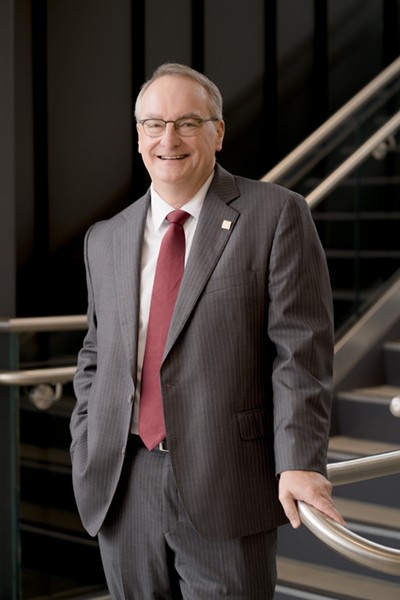
After serving as the president of Milwaukee School of Engineering (MSOE) since 2016, Dr. John Walz will become President Emeritus on Jan. 1. He will be succeeded by Dr. Eric Baumgartner. In an interview, Dr. Walz discussed his involvement in the Higher Education Regional Alliance of Wisconsin (HERA), how he has seen the organization evolve and the rising appeal of microcredential courses.
HERA: You have been involved in HERA since the early stages. How have you seen it evolve?
Dr. John Walz: The initial focus that brought us together was, how are we going to meet the demand for engineers to work on Foxconn? And when that opportunity didn’t pan out the way we expected, we realized there was value in having all the university presidents working together. There are things that we can do together that we can’t do independently. How do we help each other and be collaborative and do things that help our region?
The ability to work together with these higher education leaders has been a huge benefit beyond the stated goals of HERA. I got to know people that I would not have gotten to know otherwise.
HERA: Why do you see microcredentials as an important area of collaboration?
JW: Technology is changing so fast. There’s a need for upskilling because you could graduate with a degree in computer science and four years from now, a lot of what you learned has changed. Working professionals need a way to go back and upskill. They may not need or have time for a four-year degree. They just need to know new things.
And because technology affects so many different disciplines, it’s also a way for people to gain some expertise no matter what they got their degree in. Historically, the way to do that in college was to pick up a minor. That’s still a significant time commitment. You may not need to take three or four courses. You just want to know something about a given topic.
That’s where I think microcredentials are really important — better preparing existing college students for their careers. When the recruiter says, what do you know about artificial intelligence? They can say, I’ve got a credential in that. Or for someone who is already in the workforce, they can say, I know how to use it now even though that topic didn’t exist when I was in school.
HERA: While some people are concerned about AI, there also are opportunities for those who understand how to use it, right?
JW: Regardless of what you feel about it, it’s ingrained in so much of what we do. And there are a lot of wonderful things that can come from it. What we want to do at MSOE is let people understand how it can be used, but make sure they also understand the limitations, the pitfalls, the ethics and the biases that go into it. Because it’s here, it’s not going to go away, and it is becoming pervasive in every discipline. Some will take a little bit longer, but for the technical fields, it is here. I see it everywhere.
HERA: MSOE recently launched a “mini-MBA” microcredential course, and other institutions have launched microcredentials with support from federal funding secured by HERA. These courses are reaching people. How rewarding is that?
JW: It is extremely rewarding because I know we put a lot of work in. The mini MBA has been a great success for us, and has come from an expressed need from our many partners. They said we need people to understand a little bit more about business than what they’ve picked up in school, but they don’t want to devote the time to get an MBA. So having a mini MBA to cover the basics has been a big success. We had 24 students in the initial group, a diverse group of professionals from different companies and positions. Those 24 are all still with us, so retention has been 100%.
HERA: What did MSOE learn from the process?
JW: I talked to the director of our Center for Professional Education. And one of the things we learned is, there are some people who want to continue to get the full MBA. We want to make sure that what they’ve learned here can be used toward that.
We also learned that there’s an opportunity to expand offerings to specific fields — maybe a mini MBA for healthcare professionals or for an engineering field. That probably will be the next step in the evolution.
HERA: What does the expansion of microcredentials from HERA and its institutions mean to the region’s workforce?
JW: HERA is here to support the workforce. Microcredentials are clearly a huge part of it. Large companies have the capability to do it themselves. But for small and medium-sized companies that just don’t have that type of bandwidth, microcredentials can bring people up to speed.
I remember talking to a chief technology officer for a fairly sizable company. One of his comments to me was we have all kinds of data, we just don’t know what to do with it. I think that’s still out there. What can this stuff do for my company?
HERA: So when you look out into the future, what role do you see microcredentials playing in higher education and our broader society?
JW: They will continue to be there because the technology will continue to change. You’ve got to keep learning. Think about the advances that have happened in five years. They’re just going to keep coming. They’re going to be bigger and they’re going to happen faster. A working professional doesn’t have the time to go back and get a master’s degree. They just need to keep up to speed. And for someone getting a four-year degree, I think that the need to continue to learn is going to get greater and greater.
I graduated as a chemical engineer. I went to work for a while, and went into academics 10 years after I got my undergraduate degree. I basically taught the same material that I took 10 years before. The books were the same. Those days are gone. The physics and the fundamentals of science are still there, but how you apply it, the programs, are so much more extensive. It’s changing and you really need to be able to keep up.
HERA: With your career transition coming up, what are some high-level takeaways from your time in the Milwaukee region’s higher education landscape?
JW: One thing that came to me was how collaborative everyone is. Maybe on one level we do compete for students. But we all really want to help each other and collaborate and it’s great to work with these individuals. They all want to work together and they don’t view each other as if I help you, I hurt me. That doesn’t exist here. How do we help each other? The rising tide can raise all boats.
And some places I’ve been before, I would say I’m not sure this could have happened. They would think, why would we want to help a school when it hurts us? I don’t sense any of that here.
It’s a very unique thing that got started here. And I think it’s in good shape to continue for the future.
HERA: What are your plans?
JW: I’m not retiring. I’ll be around here helping with our campaign. I might spend a little bit more time with the grandkids. They live in North Carolina. But I will still support the university in whatever way I can.
My replacement, Eric Baumgartner, is Executive Vice President of Academics here. I told him, “Eric, my first goal is to stay out of your way. The second goal is to help you in any way that I can.” And I’ll do that for a year and a half. And then at some point then I will say, OK, it’s been great ride, and then we’ll go from there. So I’ll still be involved here, not just not as active in the day-to-day.
There are hobbies that I enjoy, like fishing. We have a house on Elkhart Lake and I love it up there. It’s just relaxing. But also continue to support MSOE in any way that I can because I love the university. The students here are great, as is the education that we provide. I want to be able to help the school as much as I can.